Anxiety is pretty annoying. Sometimes it’s scary, sometimes it’s just exhausting and sometimes it’s just there.
Here’s the thing about anxiety: it never actually leaves. It just changes form as we grow older. When you’re a kid, it’s about grades and not getting caught doing something stupid. (Trust me, I have a long track record here.) In high school, it morphs into college apps, what people think of you, whether you’re falling behind or not. Then adulthood hits and suddenly it’s job security, relationships, rent, deadlines and this whole cascading list of responsibilities that never seems to stop growing.
The specifics change. The feeling? That stays exactly the same.
But I think what people miss on is: your capacity to understand anxiety, to work with it rather than against it, grows exponentially with time. Anxiety isn’t a bug in your operating system. It’s a feature that is carved into your biology by for survival. Feeling anxious doesn’t mean you’re broken. It means you’re receiving a signal. The question is whether you know how to interpret it. Whether to say, “okay this can be ignored or that appropriate measures can be taken…..” However, most of the time, it is wiser to ignore. That’s where this mindset comes in.
Over time, I’ve developed a framework that has fundamentally changed how I respond to that signal.
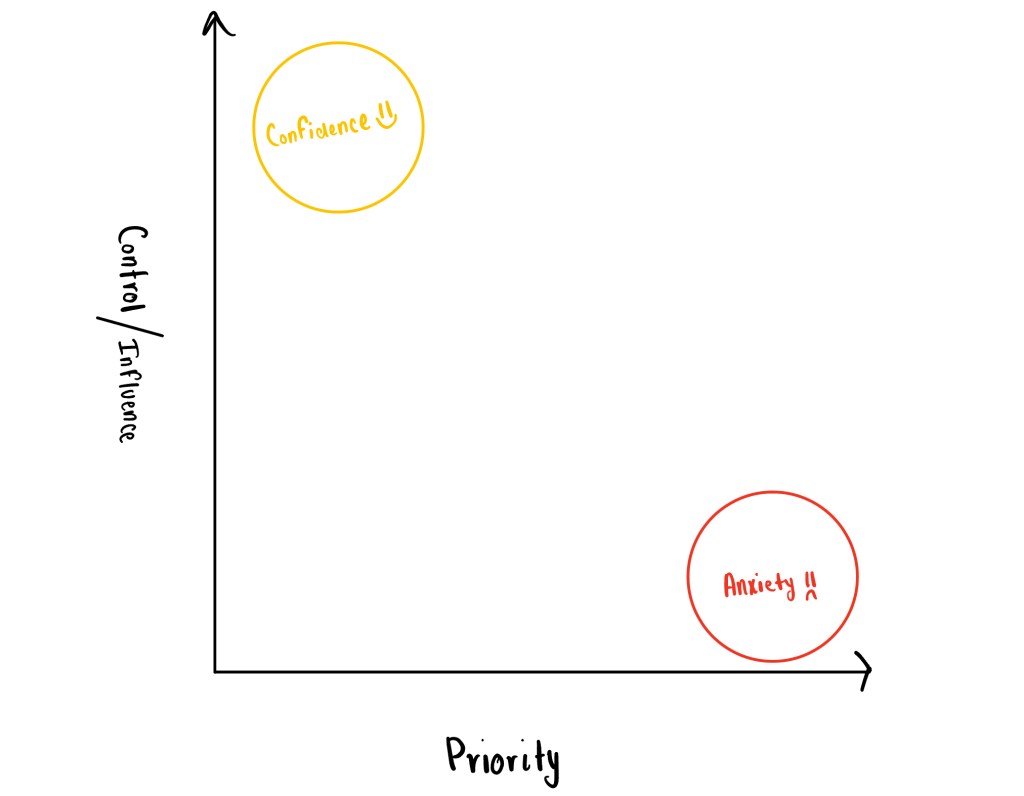
Take a look at this graph for a minute. I think understanding where anxiety gets amplified is really crucial because here’s the thing: you can’t control when anxiety shows up. It just happens. But what you can control is understanding what your anxiety actually is in reality. Am I making a mountain of a molehill? Is the data proving this…or is it my head thinking it will happen, just because it is rational?
So here’s the graph. On the x-axis, we have priority, how much the task or situation matters. On the y-axis, we have control/influence, how much you can actually affect the outcome.
The tasks that fall into the high control, low priority? Those are the things we feel confident about. Like organizing your inbox or deciding what to wear. Stuff that’s totally in your hands but doesn’t really move the needle at all.
But the things in the high priority, low control? That’s where anxiety lives. Deadlines that depend on other people. College apps. SCRUM standups where you’re blocked by something outside your control. These situations matter, but you only have such a limited amount of influence over how they turn out.
See where I’m headed?
This graph shows that these two factors, priority and control determine what a situation feels like versus what it actually is, Your anxiety might be screaming that everything is falling apart, but when you map it out, you realize: “Oh, this is high priority but low control. No wonder I’m anxious. But that doesn’t mean I’m doing something wrong.”
Here’s an example: Let’s say you’re waiting to hear back about a job you really want. High priority? Absolutely. Control? Almost none. You already did the interview. You sent the thank-you email. Now you’re just waiting. And that waiting feels terrible because your brain is treating it like an emergency you should be solving, but there’s literally nothing left to do. The anxiety isn’t telling you to work harder. It’s just reacting to the gap between how much you care and how little control you have.
Once you see that pattern, the anxiety doesn’t disappear, but it stops running the show and your actions.
So now the question becomes: how do I reframe my mindset to create a better environment for myself and for my anxiety?
The answer is simple. It’s literally the most basic metaphor we all learned as kids: the glass half full vs. half empty approach.
Here’s how most problems unfold in the half-empty mindset:
You try something new → something goes wrong → you attempt to fix it → either it works or it creates a new problem → and you end up in this branching tree where every path leads to either success or failure.
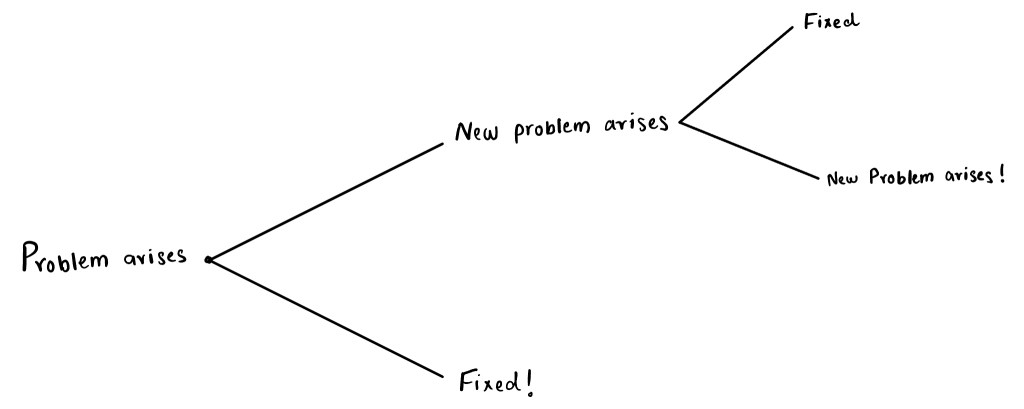
It’s a constant binary. You’re either winning or you’re taking the L. And when you’re anxious, your brain zooms in on all the failure branches. It is like every branch that results in success starts to blur out and we see the failure branch only!
Every wrong turn feels like proof you’re not good enough, that you should’ve seen it coming, that you’re falling behind.
Here’s a practical example: Say you’re learning to code and building your first web app. You get the frontend working, but then the backend breaks. You fix the backend, but now the database isn’t connecting. You Google the error, try three Stack Overflow solutions, and finally get it working, but now your CSS is broken for some reason.
In the half-empty approach, each step feels like failure. “I can’t even get this basic thing to work. Everyone else figured this out faster. I’m not cut out for this.”
But the full glass approach? Every problem you solved is progress. You learned how to debug a backend. You figured out database connections. You built something that didn’t exist before. The broken CSS? That’s just the next thing to learn, not evidence of failure.
The full glass approach doesn’t eliminate problems. It reframes them as steps forward instead of setbacks. And when you do that consistently, anxiety stops compounding. You’re not carrying this growing weight of “proof” that you’re failing. You’re just solving the next thing in front of you.
Now your body has no reason to get anxiety on failure or for that matter anything that gives nervosity, it is simply something exciting you look forward to 🙂
The results start making you smile: Way less anxiety. And actual progress.
Look, anxiety isn’t going anywhere. But neither is your ability to understand it. So as you move through this year, remember: the feeling is real, but it doesn’t always reflect reality. Map it out. Reframe it. Focus on what you can control. And when all else fails, ask yourself: is this actually a problem, or is my brain just doing its job a little too well?
You’ve got this!
@pplcallmetat
 Thenextframework
Leave a comment